


Spotify’s AI Persona Badge: What It Means for Artists and Listeners

In short: no. Spotify’s AI Persona badge is about the identity presented by an artist profile — the name, imagery, and public-facing persona — not a blanket judgment about how the music was produced.
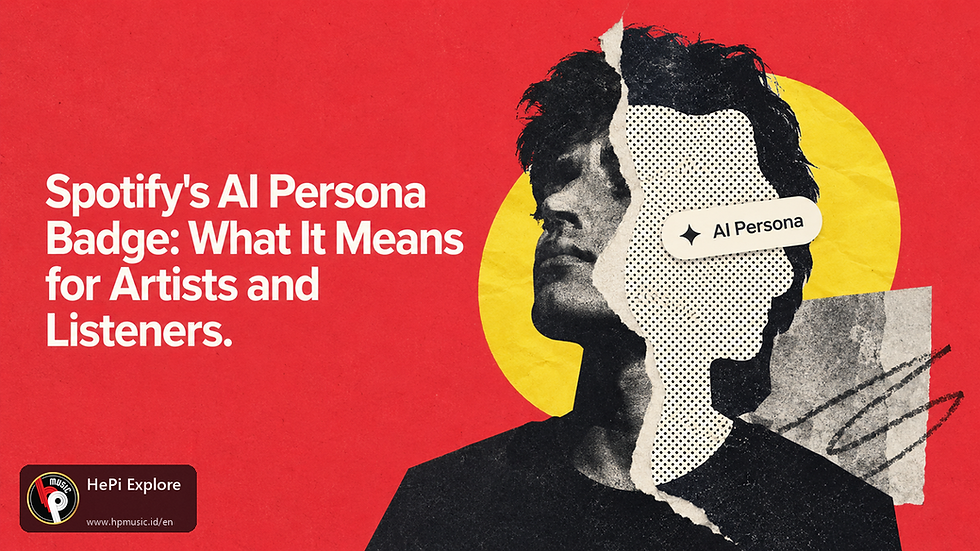
Ilustrasi editorial HP MUSIC untuk Spotify’s AI Persona Badge: What It Means for Artists and Listeners
Spotify announced the badge on 11 August 2026 and said rollout would begin in mid-September 2026 on selected profiles. The company describes it as a transparency layer for artist identities that may be AI-generated and do not represent a real person. Spotify Newsroom
That distinction matters because “AI artist,” “AI persona,” and “AI-made music” can sound like the same thing in a fast-moving feed. Spotify is explicitly separating them.
What does the AI Persona badge actually label?
Spotify says the badge concerns the public identity presented by the artist profile.
That can include the artist name, profile imagery, and the way the identity is represented to listeners. The label is meant to tell listeners when that public identity may be AI-generated rather than tied to a real person. Spotify Newsroom
This does not mean every track under that profile was fully generated by AI. Spotify says the identity badge is separate from production-related transparency tools such as AI Credits and SongDNA.
That is the first useful rule for reading the badge:
Identity transparency and music-production transparency are related questions, but they are not the same question.
Where will listeners see the badge?
Spotify said the AI Persona badge would appear in several places where listeners encounter an artist identity, including artist-profile banners and About sections, Search, and track rows across playlists. Spotify Newsroom
That placement is significant because it moves the disclosure closer to the moment of discovery.
A listener may never open an About page. But if the label appears during Search or on a playlist track row, the context arrives before a listener has to investigate the profile manually.
For platforms, that is an important design choice: transparency only helps if people can actually see it where decisions are being made.
Does the badge affect recommendations?
According to Spotify, AI Personas are excluded by default from editorial and algorithmic recommendations unless a listener follows them or otherwise intentionally engages with them. Spotify Newsroom
That is more than a visual label.
It means Spotify is combining disclosure with a distribution rule. The policy, as announced, does not simply tell users “this identity may be synthetic”; it also changes how those profiles can enter passive discovery surfaces by default.
This does not prove that every AI-labeled artist will have the same audience outcome. Recommendation systems involve many signals, and listener behavior still matters. The more modest point is that Spotify has said these profiles are treated differently in default recommendation pathways.
The badge is not only a label. It is also part of a discovery policy.
Who decides whether a profile gets the badge?
Spotify says artists can self-disclose an AI Persona through Spotify for Artists.
But self-disclosure is not the only route. Spotify also says it reviews relevant profiles and can apply the badge independently. The company said its review focuses on the public identity presented by the profile and initially prioritizes profiles that meet defined audience thresholds. Spotify Newsroom
Profiles labeled after Spotify review are notified and given an opportunity to self-disclose or appeal.
That creates two different paths into the same label:
an artist or team discloses the AI Persona themselves;
Spotify reviews the profile and applies the label.
For artists, this means the badge is not purely voluntary once a profile falls within Spotify’s review scope.
What does the badge not tell you?
This is where the policy can be misunderstood.
The badge does not mean:
every vocal was AI-generated;
every instrument was synthesized by AI;
no human wrote, produced, mixed, or performed on the recording;
the release is fake;
the music violates platform rules;
the artist has no rights to the recording.
Spotify’s announcement does not support those conclusions.
The badge addresses identity representation. Production-related AI disclosures are handled separately. That separation is useful because a virtual persona could release music made heavily by humans, while a real human artist could use AI tools somewhere in production.
The identity and the production process can overlap, but one does not automatically prove the other.
Why does this matter for artists?
If a project intentionally uses a synthetic or fictional public persona, Spotify’s policy creates a clearer expectation that the identity may be labeled. Teams should therefore treat identity presentation, profile imagery, metadata, and disclosure as part of release planning rather than as an afterthought.
A useful pre-release check is:
Is the public-facing artist identity a real person, a fictional character, a virtual act, or a hybrid?
Could the profile imagery or naming imply a real person when none exists?
Is the team prepared to explain the relationship between the persona and the people making the music?
If Spotify applies a badge, is the profile information accurate enough to support an appeal if the label is wrong?
The decision is not “avoid AI” or “embrace AI.” The practical decision is to make the identity architecture intentional and defensible.
Why does this matter for listeners?
For listeners, the badge adds context that used to require guesswork.
That does not mean the label tells you whether a song is good, meaningful, original, or emotionally valid. Those are different judgments.
What it does give you is one additional fact about the identity being presented.
If a voice, face, name, or visual persona feels like a real human artist, the badge can help clarify that the public identity may instead be synthetic. That can matter for listeners who care about authorship, fandom, authenticity, attribution, or simply understanding what they are following.
A useful listener question is not “Is AI music bad?” It is:
What exactly is synthetic here — the identity, the production process, or both?
The badge answers only part of that question.
What changes — and what stays unresolved?
Spotify’s policy is a platform-specific transparency system, not a universal definition for the music industry.
Other platforms may use different labels, thresholds, recommendation rules, or definitions. Spotify’s own implementation can also evolve after rollout.
So the current policy should not be treated as a permanent industry standard.
What is clear from Spotify’s announcement is narrower:
the company is distinguishing AI-generated public identity from AI use in music production;
it plans visible labeling across several discovery surfaces;
self-disclosure and platform review can both lead to a badge;
labeled AI Personas are treated differently in default editorial and algorithmic recommendation pathways.
What remains unresolved is how listeners, artists, labels, distributors, and other platforms will respond as synthetic identities become more common.
The useful takeaway
The most important thing about Spotify’s AI Persona badge is the boundary it draws.
It tells listeners something about who or what the artist profile represents. It does not, by itself, tell them exactly how the music was made.
For artists, that means identity transparency is becoming part of platform strategy.
For listeners, it means one less layer of ambiguity when a profile looks human but may not represent a real person.
And for the industry, it suggests a broader shift: the question is moving from “Was AI used?” to a more precise set of questions about where AI is used, what is being represented, and what should be disclosed.
Sources
Spotify Newsroom, 11 August 2026: AI Persona badges and transparency


Comments